Hello Beautiful People,
This entry was inspired by people wanting to shorten/change my name to make it easier for themselves. I would usually be upset but I would just remind the person of my name, or how to pronounce it. Around this time I have been looking at my requirements to become a US Citizen, and there’s a section saying, now that you will no longer be a Permanent Resident, you can change your immigrant name to an American one! (Those are not the exact words, but that’s the gist of it). I love my name, however, this whole process has made me reflect on how we all call ourselves even more.
I grew up in a family where all our names have meanings – one more beautiful than the other. It was always my understanding that people should have beautiful names or at least meaningful ones. However, as I got older and moved to the United States, I noticed that names are not necessarily as valued by everyone as they were by my family and me. But the value of names is not individual to me. Many cultures and traditions use names to show certain traits, values, and honor history.
Names are a vital part of our identity. They carry deep personal, cultural, family, and historical connections. They can give us a sense of who we are, the communities we belong to, and more. Many families choose to use the same name for generations, this creates a certain bond or honors a certain family member who has passed. Many people have last names whose meaning goes back in time to the profession or quality an ancestor had, etc. There are people who choose their names, to represent themselves better.
The Meaning of Ensara
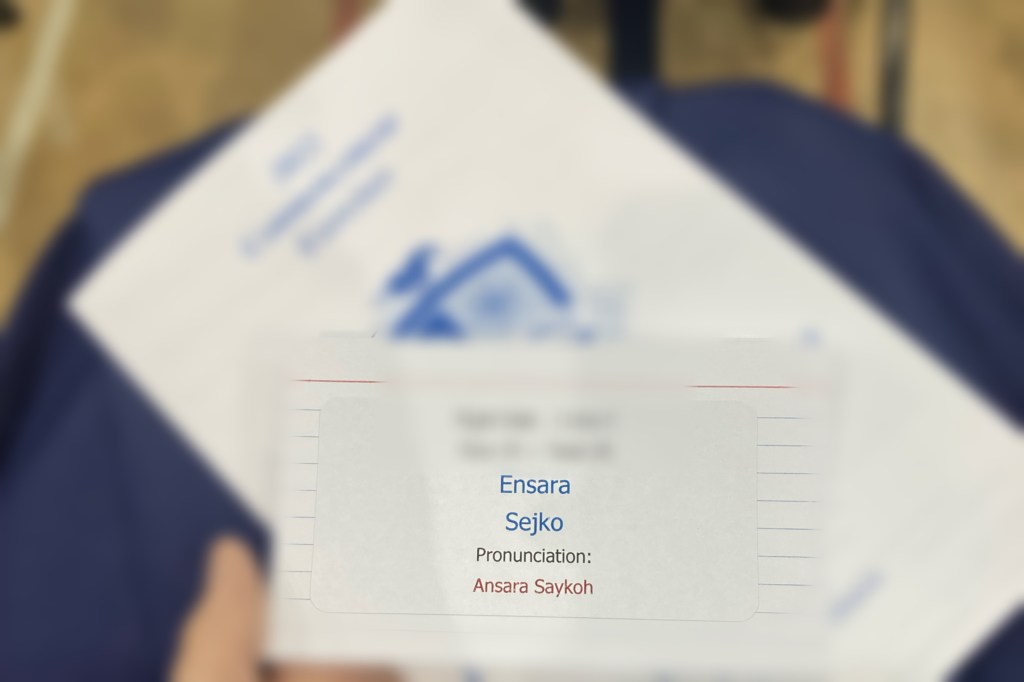
Since my own name is what allowed me to reflect more on the value of names overall, what does Ensara mean? The name Ensara comes from the word Ansar, أنصار. The Ansar were the local inhabitants of Medina who took the prophet Muhammad saws and his followers into their homes and welcomed them into their community when the Prophet and Mecca-Muslims migrated from Mecca to Medina during the hijra. Ensara basically means someone who puts others before themselves and helps whoever needs it. It can be found in several other examples, but this is one of the most significant contexts.
Ensara / Ansara (female)
Ensar / Ansar (male)
“Oh, Ensara? That’s kinda hard. Do you have like an American nickname?”
In my opinion, while my name is “rare” and lovely, it’s also a very simple name. Ensara. E-N-S-A-R-A. Six letters, three syllables. It doesn’t get any easier. So if it’s hard to say or difficult to remember I am happy to say it again. It is so much better to try and learn someone’s name correctly than ask them to change the name so it’s more fitting for you, it simply makes no sense. If we can learn to remember and differentiate between Kaylee, Kayleigh, Kaylie, Caileigh, etc, you can surely remember Ensara or any other seemingly “difficult” name.
“Ensara, Sara, it’s basically the same thing.”
It is not. The name Sara sounds and looks different, and most importantly has a different meaning. Sara means “princess, queen, pure, high lady, etc”, and we have already established what Ensara means. Both are beautiful names, both meaningful, but cannot be used interchangeably unless a person wants to go by Sara. But that is not a decision for others to make. Whatever the name may be, people with “ethnic” names, or otherwise names you may not be familiar with, do not have to use an alternate name that is similar to what you may be used to. If I had a nickname I would like people to use, I would simply mention it. There is no need for people to find “easier” ways to say my name.
Beyond my personal experience, there are plenty of cultures that place value on the way one is named.
The Value of Names – Nigeria
Professors Gladys I. Udechukwu and Nkoli Mercy Nnyigide write about the significance of names in Nigeria. “In Africa, particularly in Igbo land, names given to children are sacred because they are given before the presence of both the living (man) and the dead (spirit) as witnesses. Name and naming ceremony in Igbo land especially in Anambra State of Nigeria is a very important issue that cannot be toyed with.” The names chosen for children carry not only cultural significance but also a religious one. Oftentimes honoring ancestors or events of the past.
The Value of Names – Hawaii
In Hawaiian language tradition, it is believed that words have power; a name is a person’s most precious possession, a force unto itself. This is common across many traditions of course, and especially in those who have gone through attempts of history erasure, etc, names play an important role in a person’s identity. In the words of Mary Kawena Pukui, “A name became a living entity…identified a person and could influence health, happiness and even life span.”
The Value of Names – South Korea
Nina Evason writes for the Cultural Atlas, that “it is a common belief that a good name brings luck, and an unfit name may bring bad luck. Therefore, Korean parents generally prefer to choose names that embody goodwill, prosperousness and have positive connotations in their meaning and sound. Names may be chosen in accordance with a child’s birth date and time, as well as the number of strokes of the name in Korean characters, to assure it is auspicious.” This tradition and belief is a pattern that can be seen across many traditions, but each one adds its own cultural touch.
—
I think about names given in Albania. All beautiful names, with meanings that honor things such as generosity, bravery, etc. Or names that belong to elements of flora and fauna. Now that I am in a different country, if I read a name I can usually tell right away if that name is Albanian, and that makes me happy to be able to recognize someone of a similar culture in such a simple way. But simultaneously, many Albanians that immigrated to Italy, Greece, the USA, etc, changed their names to sound more like the country they were in, so they could avoid discrimination. While in some cases it was necessary, for a country so small if we begin losing our names while far from the homeland, the culture, language, and heritage can begin losing itself too.
No matter if it’s due to heritage, or simply just one’s individuality, names should be respected. How we call ourselves and want others to call us, is a huge part of building one’s identity. There is so much more depth to this topic, and many cultures value names in similar ways, but this was a quick reflection on my own experiences and conversations.
Thank you for reading!
Stay warm!
Ensara Sejko
References
- Udechukwu, Gladys I., and Nkoli Mercy Nnyigide. “The Religious and Socio-Cultural Implication of African Names: Igbo Naming System as a Paradigm.” AFRREV IJAH: An International Journal of Arts and Humanities 5, no. 3 (2016): 89–103. https://doi.org/10.4314/ijah.v5i3.8.
- Wizinowich, Jan. “Hawaiian Naming Traditions: A Cultural Legacy.” Ke Ola Magazine, August 15, 2020. https://keolamagazine.com/culture/hawaiian-naming-traditions/.
- Evason, Nina. “South Korean Culture – Naming.” Cultural Atlas, 2021. https://culturalatlas.sbs.com.au/south-korean-culture/south-korean-culture-naming.
 ensara's corner
Leave a comment